
Meet the Artists and Makers of The Arts Trail
There are easier ways to see art than driving between studios.
But if you want to understand it, this is where you come.
The Arts Trail is not built around a single style or scene. It is built around people. Different practices, different materials, different reasons for making the work in the first place. You start to notice that pretty quickly once you step inside the spaces.
At Tom Ashbourne Studio & Gallery, the work is defined by scale and material. Stone, weight, texture. The sculptures feel grounded and deliberate, with a presence that does not translate the same way in a photo. You move around them, taking in each angle, noticing how light and form interact. It’s the kind of work that asks you to slow down and really look. Ashbourne’s abstract sculptures are shaped through a direct relationship with the material, defined by curves, movement, and surface.
A few minutes away, the tone shifts at J. Douglas Thompson Fine Paintings. Here, the focus is on light and water. The work feels quieter, more atmospheric. You’re not just looking at a landscape, you’re noticing how it changes. Through cloudscapes, waves, and reflections, Thompson’s acrylic paintings capture movement in a way that feels both natural and deeply personal.
At Melt Studio & Gallery, artist Susan Wallis works in encaustic, a process that layers heated wax and pigment to build depth and texture. The studio and gallery sit side by side, so you are not just seeing the finished piece. You are seeing how it comes together. It makes the work feel less distant and more considered.
At ANDARA Gallery,the experience is shaped by two very different approaches to image-making.
Andrew Csafordi works in encaustic, building his paintings with layers of molten beeswax and pigment. The result is textured, luminous, and slightly abstract, with landscapes that feel more like impressions than exact representations.
In the same space, Tara Wilkinson approaches things through the lens of photography. Her work focuses on nature, light, and human experience, often capturing moments that feel quiet but intentional. It is less about documenting a place and more about noticing something within it.
Together, the gallery does not feel like a single perspective. It feels like a conversation between two ways of seeing.
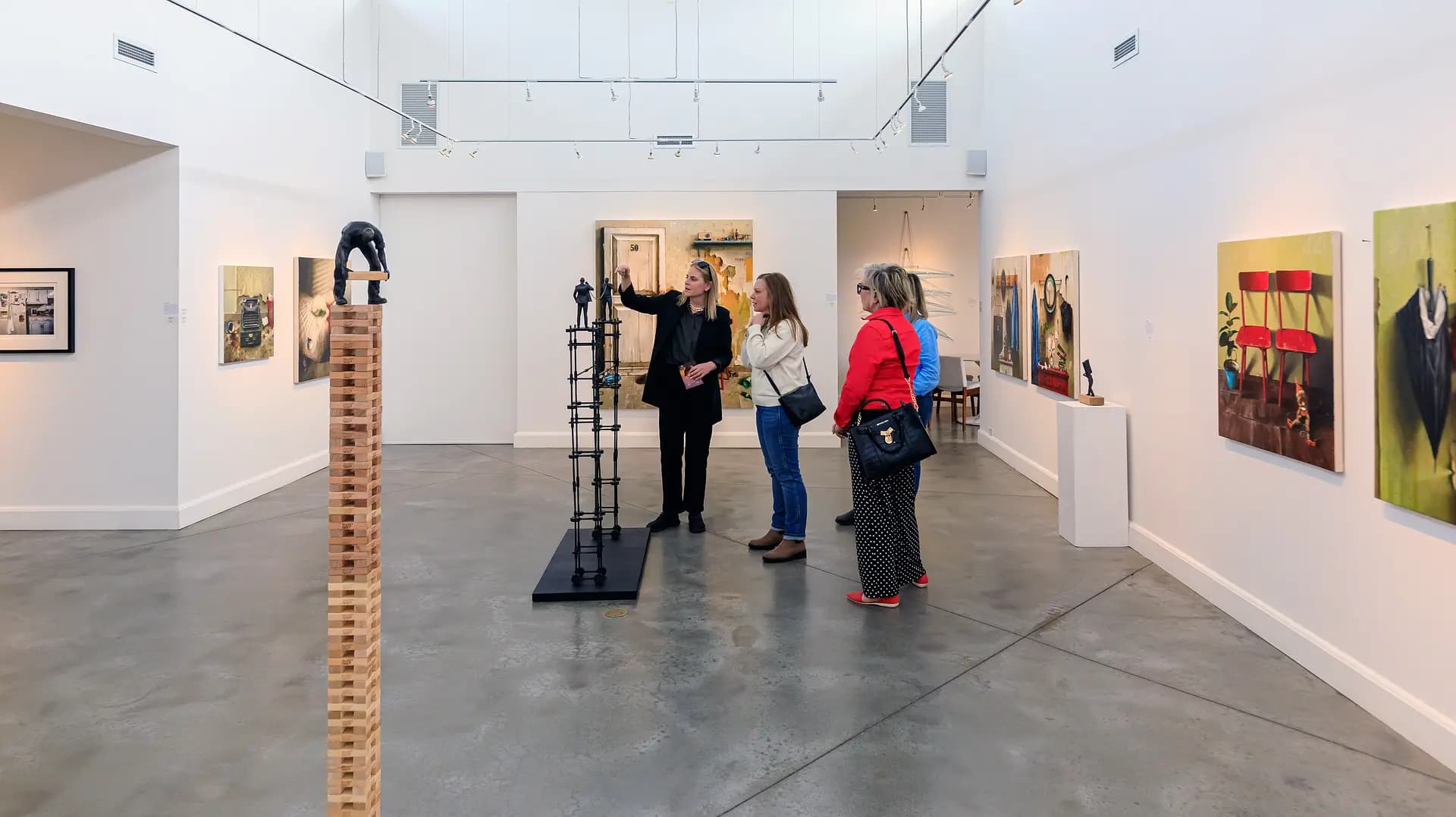
At Oeno Gallery, art expands beyond the walls themselves. Set among the vineyards at Huff Estates, the experience moves between contemporary gallery spaces and a large-scale outdoor sculpture garden where landscape, scale, and perspective become part of the work itself. With rotating exhibitions and artists from across Canada and beyond, the space encourages visitors to slow down, wander, and experience art in a more immersive way.
At Guildworks, the focus shifts again. This is where art moves into daily life. Ceramics, textiles, glass, objects that are meant to be used and lived with. The work comes from makers across Canada, but the throughline is the same. Attention to detail. Material. Process. Things that are built to last.
At County Creative, the relationship between art and community feels especially visible. Alongside a curated gallery featuring Canadian artists, the studio invites visitors to participate directly through drop-in pottery painting, rotating workshops, and creative events that bring people together around making something side by side. The space feels approachable and social, where conversations happen naturally across the table and creativity becomes something shared rather than simply observed.
Mad Dog Gallery brings together a wide range of local County artists working across painting, ceramics, textiles, and mixed media. Set inside a renovated timber-frame barn near East Lake, the gallery reflects another important part of the Arts Trail: spaces where creativity feels connected to place, community, and everyday life.
What connects all of these places is not a single style. It is the fact that the work is tied closely to the people making it.
You are not just seeing finished pieces. You are seeing decisions, materials, time, and practice.
And once you start to notice that, it changes how you move through the rest of the trail.